The BBC is the British press in Google AI Overviews
In UK news AI Overviews, the BBC alone takes 4.4% of citations, more than the Guardian, the Sun and the Mirror combined, while certified press gets 5.9%.
Par Gilles Helleu
The gist in 4 lines: on 2,998 distinct UK queries on news topics measured every day from 19 to 25 August 2026, Google shows an AI Overview in 57.9% of cases. Out of the 58,384 citations logged in those answers, bbc.co.uk and bbc.com receive 2,573, or 4.4%, more than the Guardian, the Sun and the Mirror combined. All strictly certified press together gets 5.9% (7.8% with regional titles and magazines). The 50 biggest UK news brands by audience get 16.1%, and audience does not predict citation: the Daily Mail, tenth brand in the country, receives 17 citations in seven days.
Where these figures come from
This article is a satellite of our study Study: on the news, Google's AI cites social media before the press. Two frozen panels of 2,998 distinct queries on news topics, one panel per country, were built from topics actually in the news (people, events, cases, works, companies) and submitted every day around 15:00 UTC to Google UK and Google France, at country level, desktop results, through DataForSEO's SERP API with AI Overviews loaded. The panels are drawn from demand, not from the media: the topics are the most viewed Wikipedia pages in each country from 5 to 18 August 2026, compared with their July audience, then matched with the queries actually typed into Google through DataForSEO Labs, with a draw stratified by theme and by volume band. These are queries on topics that made the news rather than breaking-news queries in the strict sense, and since the panel is derived from Wikipedia entities, Wikipedia's place among cited sources is partly a construction effect. For each of the 41,971 records (2,998 distinct queries per country, the 3,000-query draw containing two duplicates) we kept the presence of an AI Overview, the full list of cited sources and the organic top 10.
Cited domains were classified mechanically against public reference lists: certified press (PAMCo, Newsworks and Newsquest brands for the UK, completed with Reach plc regional titles and a few national magazines), broadcast news (BBC included), TV listings, Wikipedia, social networks and video platforms, and everything else. Every rate comes with a 95% confidence interval. The method, the CSV files and the aggregation report are on the study page.
1. One broadcaster outweighs the national press
Over seven days, UK AI Overviews on news queries produced 58,384 citations across 2,826 distinct domains. The BBC, counting bbc.co.uk (1,423 citations) and bbc.com (1,073), receives 2,573 of them, 4.4% of the total, on 525 distinct queries.
Now the certified press. The Guardian receives 1,051 citations, the Sun 477, the Mirror 356. Added together, the three most cited national titles reach 1,884, still short of the BBC on its own. The Independent and the Times get 307 each, the Telegraph 199, the Standard 164, Metro 106. The Guardian alone takes 31% of the citations going to strictly certified press.
Take every strictly certified press title together and they weigh 5.9% of UK citations 5.7 ; 6.1, 7.8% with regional titles and magazines. The BBC alone weighs three quarters of the strict figure, 56% of the wider one.
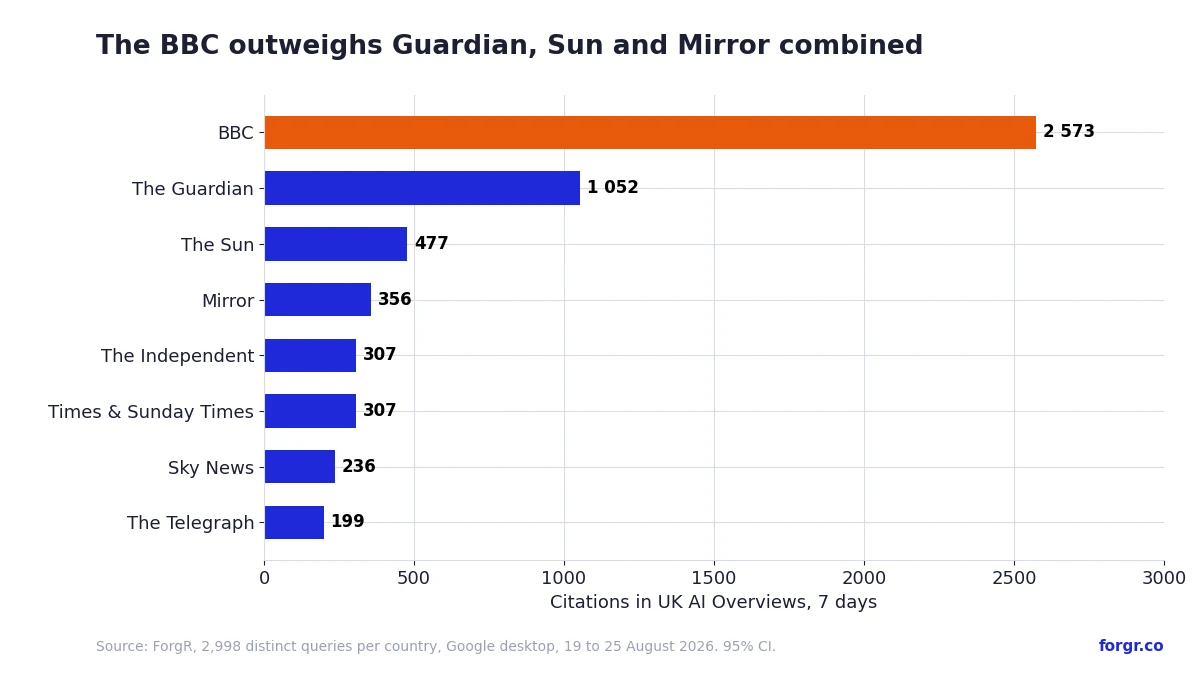
Remove the BBC and the broadcast picture shrinks fast. ITV receives 104 citations over the week, Channel 4 receives 46, Sky News 236. Broadcast news as a category weighs 5.1% of citations, and the BBC is 4.4 of those 5.1 points.
2. The Press Gazette top 50: 16.1% of citations, heavily concentrated
We crossed the UK citations with the ranking of the 50 largest news brands by audience published by Press Gazette (Ipsos iris data, June 2026). These 50 brands receive 16.1% of all citations 15.8 ; 16.4. 46 of them are cited at least once in seven days.
The distribution inside that 16.1% is steep. The BBC and the Guardian capture 38.5% of the citations going to the top 50. Four brands are never cited (Good Food, Good Housekeeping, Which? and Healthline Media) and three more get a single citation in seven days: Money Saving Expert, Cosmopolitan and Digital Spy. Several of those are not news publishers in the strict sense; we report the list as it stands.
3. Audience does not predict citation
If Google's AI answers followed reach, the ranking of citations would look like the ranking of audiences. It does not.
The Daily Mail is the tenth brand in the country with 16.8 million monthly readers. It receives 17 citations in seven days, on 8 distinct queries, 0.03% of all citations. We checked the raw records: dailymail.co.uk does not appear in the organic top 10 of the AI Overview pages in this panel (7 appearances across the whole UK collection, all on pages without an AI answer), and dailymail.com ranks 23 times in those top 10s, never in the top 3, for the 17 citations. The AI does not push the Daily Mail aside; organic search does not rank it. The Daily Express (17.8 million readers) gets 104, the Daily Star 17, GB News 10, the Financial Times 4.
Meanwhile People.com, an American magazine ranked 43rd with 3.0 million UK readers, receives 694 citations, more than the Sun (477) with its 20 million readers. Yahoo!, a platform rather than a publisher, receives 819. Forbes, ranked 33rd, gets 345, more than the Telegraph, the Times or the Independent.
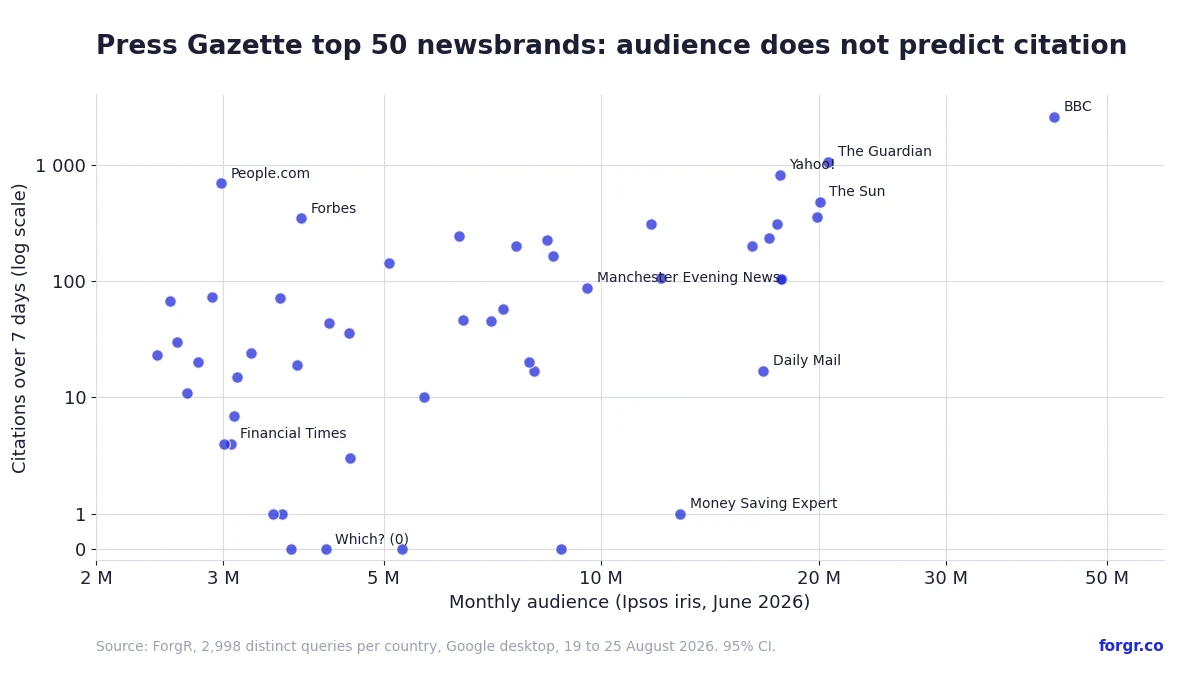
Two readings are possible and the data does not decide between them. Either Google's answer engine selects sources on criteria unrelated to audience (topic fit, page structure, presence in its index), or some publishers have restricted how their content is used in AI answers. This study measures who Google cites, not why. Only the publishers, or Google, can say whether a technical or contractual choice is involved.
4. The British press is cited far less than the French press
Same method, same week, same panel size in France: certified press receives 16.0% of citations there 15.7 ; 16.3, against 5.9% in the UK (7.8% with regional titles and magazines). All media (press, broadcast, TV listings) reach 20.2% in France and 13.3% in the UK. And 51% of French AI Overviews cite at least one media outlet, against 37% of British ones.
That comparison needs a caveat, and we state it plainly. The French list is the ACPM's certified websites, named one by one. The UK list is reconstructed from PAMCo, Newsworks, Newsquest and Reach, and under-represents local press outside those groups. The France / UK comparison on press in the strict sense is therefore indicative, and on topics of national origin alone the gap narrows (21.5% in France, 12.8% in the UK with the additions, 9.5% on the strict scope). The "all domains" and "all media" perimeters are comparable, and they point the same way.
What UK AI Overviews cite instead: Wikipedia (13.3% of citations, en.wikipedia.org alone 12.0%), social networks and video platforms (21.2%, led by Facebook, YouTube, Instagram and Reddit), and a large "other" category (52.3%: institutions, official sites, databases such as IMDb and Britannica, brands, plus about 1,700 citations of non-certified foreign press such as people.com, forbes.com, businessinsider.com, nytimes.com and variety.com, 2.9 points the press loses by construction). On a news query about a public figure, Google's AI cites the person's Facebook page or Instagram account more often than the article about them.
What this means as the CMA sets the rules
The Competition and Markets Authority has designated Google as having strategic market status in search and is working on the conduct requirements that will frame, among other things, how publisher content is used in Google's AI answers. We will not guess where that lands or when. What this measurement adds is an order of magnitude that was missing from the debate: on news queries, over a full week, strictly certified press receives 5.9% of citations (7.8% with regional titles and magazines), the BBC 4.4%, Wikipedia 13.3%, social platforms 21.2%.
Three points for publishers reading these figures.
Audience is not a shield. The Daily Mail is almost absent, People.com is ahead of the Sun. Whatever drives selection into AI answers, it is not reach.
Concentration is extreme. Ten domains capture 73.4% of the citations going to UK media. Outside the BBC, the Guardian and a handful of nationals, being a media brand does not translate into being cited.
A citation is not a click. This study measures who Google names, not who gets traffic. Being named inside an answer that already contains the answer is not the same as ranking first on a page that sends readers through.
Limits
Desktop only, one location per country, seven consecutive days in August 2026. The AI Overview rate itself moved over the week (55.8% on 19 August, 59.9% on 25 August in the UK), so these are dated figures. Press reference lists are not symmetrical between France and the UK, as explained above. Source classification is mechanical, by domain: a site absent from the reference lists falls into "other", which may slightly understate the press, more likely in the UK than in France. The Press Gazette cut relies on a hand-made mapping of brands to domains (BBC = bbc.co.uk + bbc.com, Daily Mail = dailymail.co.uk + dailymail.com, for instance).
A ForgR study, conducted by Gilles Helleu and Paméla Michel, co-founders. Every figure can be recomputed from the CSV files published under CC BY 4.0 on the study page. Raw per-query records are available to researchers and journalists on request.