Study: Google's AI cites social media before the press
2,998 distinct queries per country over 7 days: Google shows an AI answer on 57.9% of UK queries and 50.9% of French ones. UK press gets 5.9% of citations.
Par Gilles Helleu
The gist in five points
- On the news, Google's AI cites social networks and video platforms first (Facebook, YouTube, Instagram, TikTok, Reddit, X, LinkedIn, Threads, Pinterest): 21% of citations in the UK and 23% in France, against 5.9% (7.8% with regional titles and magazines) and 16% for certified press. True in both countries, on 14 of the 16 country × theme crossings; in France, on the media and business themes, press and social platforms are neck and neck (media: press 1,536 citations, social 1,493; business: social 1,294, press 1,188).
- One query in two shows an AI answer: 57.9% in the UK, 50.9% in France, across 2,998 distinct queries on news topics per country measured every day from 19 to 25 August 2026. But the more a query is searched, the less the AI answers: 12% above 10,000 monthly searches.
- In the UK, the BBC alone gets 4.4% of citations, three quarters of what strictly certified press gets. Audience predicts nothing: the Daily Mail gets 17 citations in a week, People.com 694.
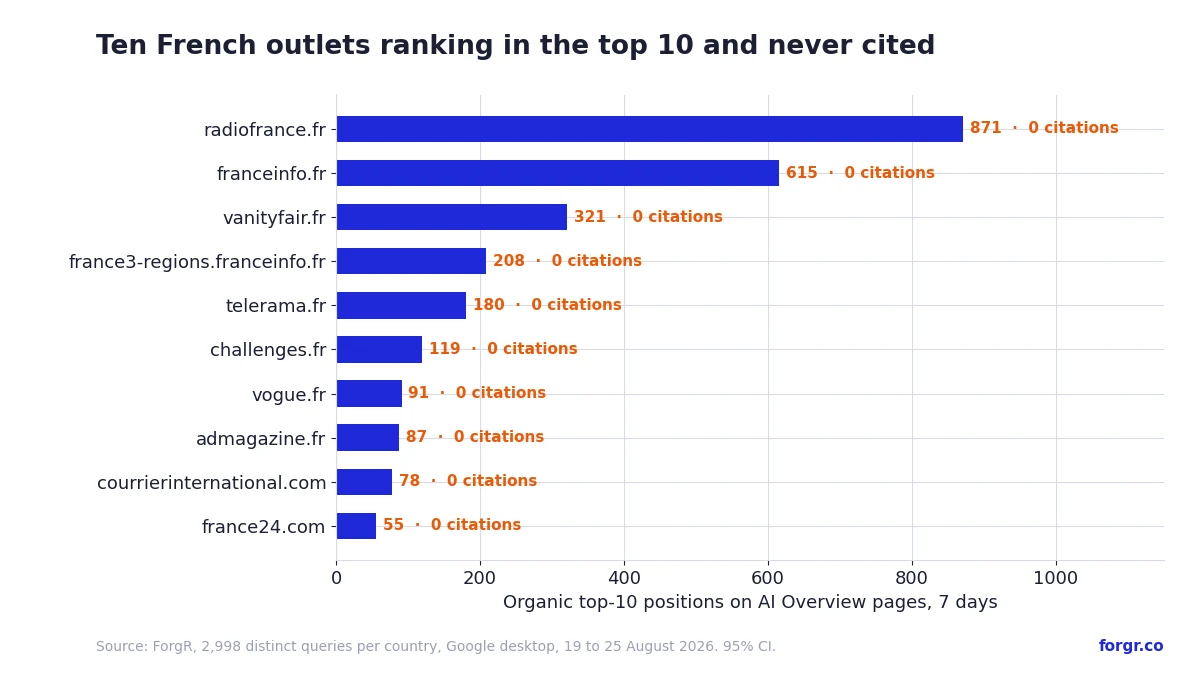
- Ten French outlets, including Radio France, franceinfo, Télérama and Vanity Fair, rank in the top 10 of AI-answer pages and are never cited there. No comparable case in the UK.
- One query in four sees its AI answer appear or disappear within the week: a single-day measurement is a snapshot, not a state.
Why this measurement, and why now
Two French measurements came out while we were collecting, and they converge with ours. The Black Room, a collective of SEO consultants, measured 25,000 news and entity queries on 9 August (mobile, a single day): 55% AI Overviews, at least one ACPM press title cited in 40% of cases, Gala the most cited press title, Wikipedia at 14% of citations (Blog du Modérateur, 25 August 2026). SE Ranking measured 100,000 queries on 7 and 8 August: 52.6% AI Overviews (La Tribune, 26 August 2026). Our French figures are in the same range (50.9%, 44% of answers citing a press title, gala.fr first), which strengthens both measurements. What this study adds: the UK side by side, seven days instead of one, confidence intervals, the search-volume effect, the cut keyed to the top 50 UK news brands, and the ten French outlets that rank but are never cited.
Almost every published study on AI Overviews measures commercial or generic informational queries, on a single day, and most often in the United States. Our own study of 12 August, Wikipedia barely registers, covered French buying queries collected once. Publishers, for their part, want to know what happens on the queries that drive their traffic: the names, the events, the stories of the moment.
The timing matters. In the UK, the question is already regulatory: the Competition and Markets Authority has designated Google as having strategic market status and is preparing the conduct requirements that will govern the use of press content in its AI answers. In France, Google launched AI Overviews on 22 July 2026, after offering publishers, in a letter dated 29 June, an opt-out from AI Overviews and AI Mode presented as having no effect on indexing or ranking. On 23 July, the magazine publishers' union (SEPM) denounced a "manifest breach of Google's commitments". On 11 August, the general-interest press alliance (APIG) filed a complaint with the French competition authority. On both sides of the Channel, the same question is being asked, and no field data is circulating.
So we built the measurement that was missing: two markets, one news panel per market, seven consecutive days, and a full record of who gets cited. The raw data can be downloaded from the study page, and every figure can be recomputed.
Methodology
Two panels of 2,998 distinct queries on news topics, one for the UK, one for France, built from topics actually present in the news when the panels were assembled, then frozen for the whole measurement period. Each query carries a theme, a register (biographical, factual, news, practical, detected by keywords in the query), a topic origin and a monthly search volume. The queries are those associated with these topics in keyword data: a name, a name and a word, a short question.
A panel drawn from demand, not from the media. The topics are the most viewed Wikipedia pages in each country from 5 to 18 August 2026, compared with their July audience so as to keep only what made the news, typed through Wikidata, then matched with the queries actually typed into Google and their volumes through DataForSEO Labs, with a draw stratified by theme and by volume band. These are therefore queries on topics that made the news, not breaking-news queries in the strict sense (86 French and 77 British queries carry an explicit news marker; the others are about the entity itself). Since the panel is derived from Wikipedia entities, Wikipedia's place among cited sources is partly a construction effect.
Seven daily collections. Each query was submitted every day around 15:00 UTC, from 19 to 25 August 2026, to Google UK and Google France, at country level, no city, on desktop, through DataForSEO's SERP API with AI Overviews loading enabled. For each record: whether an AI answer was present, the full list of cited sources, the first ten classic results. 2,998 distinct queries per country (the 3,000-query draw contains two duplicates), 41,971 records over seven days. A second collection on 19 August, run in the afternoon to test the protocol, is excluded.
Source classification by public reference lists, with no manual judgement: certified press (PAMCo, Newsworks and Newsquest brands in the UK, plus Reach plc's regional titles and a few national magazines; in France, ACPM-certified written press, excluding TV listings and broadcasters, so franceinfo.fr and radiofrance.fr are classified as broadcast), broadcast news (BBC included), TV listings, encyclopedias, social networks and video platforms (Facebook, YouTube, Instagram, TikTok, Reddit, X, LinkedIn, Threads, Pinterest), and everything else.
Confidence intervals everywhere. Every rate comes with a 95% confidence interval. Seven-day averages are bootstrapped over queries, which avoids counting the same query seven times as seven independent observations. UK / France gaps are read on those bootstrap intervals.
The lessons
1. On news, the AI answer is already the majority
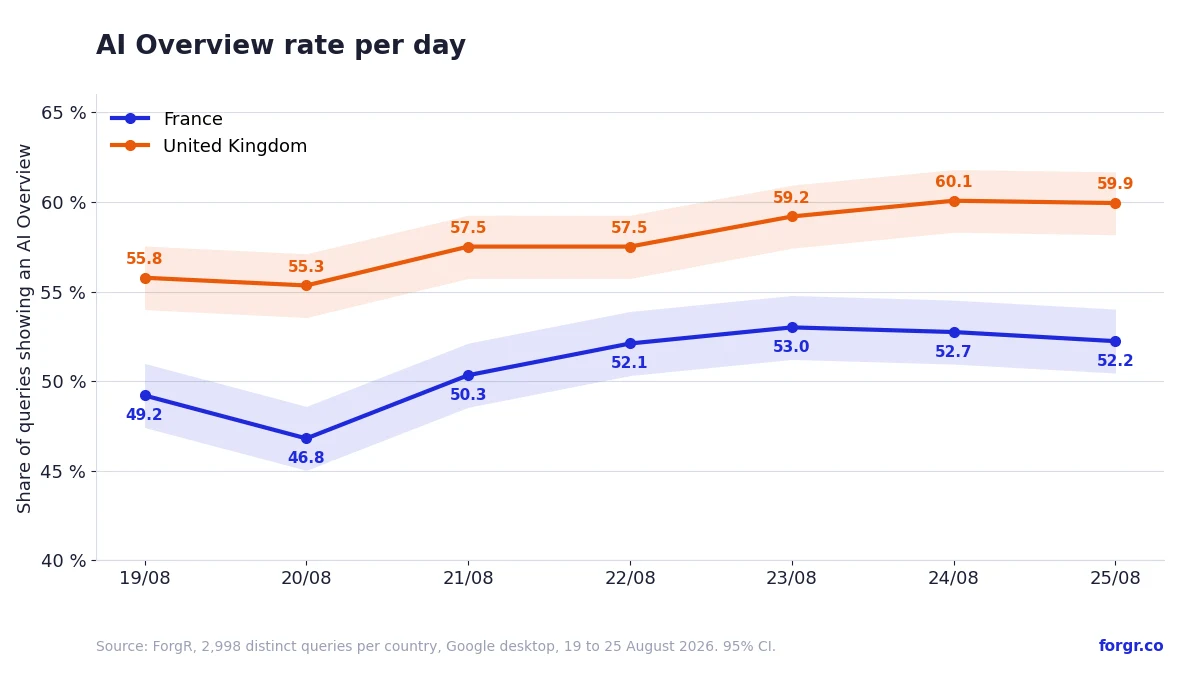
Averaged over seven days, 57.9% of UK queries 56.3; 59.5 and 50.9% of French ones 49.3; 52.5 show an AI Overview. The seven-point gap between the two countries owes nothing to chance: the bootstrap intervals do not overlap. But the two panels are not identical (themes, volumes, 29% of American topics on the UK side); weighted by theme, the gap widens to 10 points (57.8% against 47.9%).
The measured week is not flat. The UK goes from 55.8% on 19 August to 59.9% on the 25th; France goes from 49.2% to 52.2%, with a dip to 46.8% on the 20th. The rate climbs by 3 to 4 points between 19 and 25 August, then levels off in France from the 22nd to the 25th (52.1 / 53.0 / 52.7 / 52.2). Two readings are possible, and our data does not decide between them: Google is extending coverage; or the panel's topics, frozen on 18 August, are cooling down, and Google withdraws Top Stories where the AI Overview takes their place.
2. The more a query is searched, the less Google answers it with AI
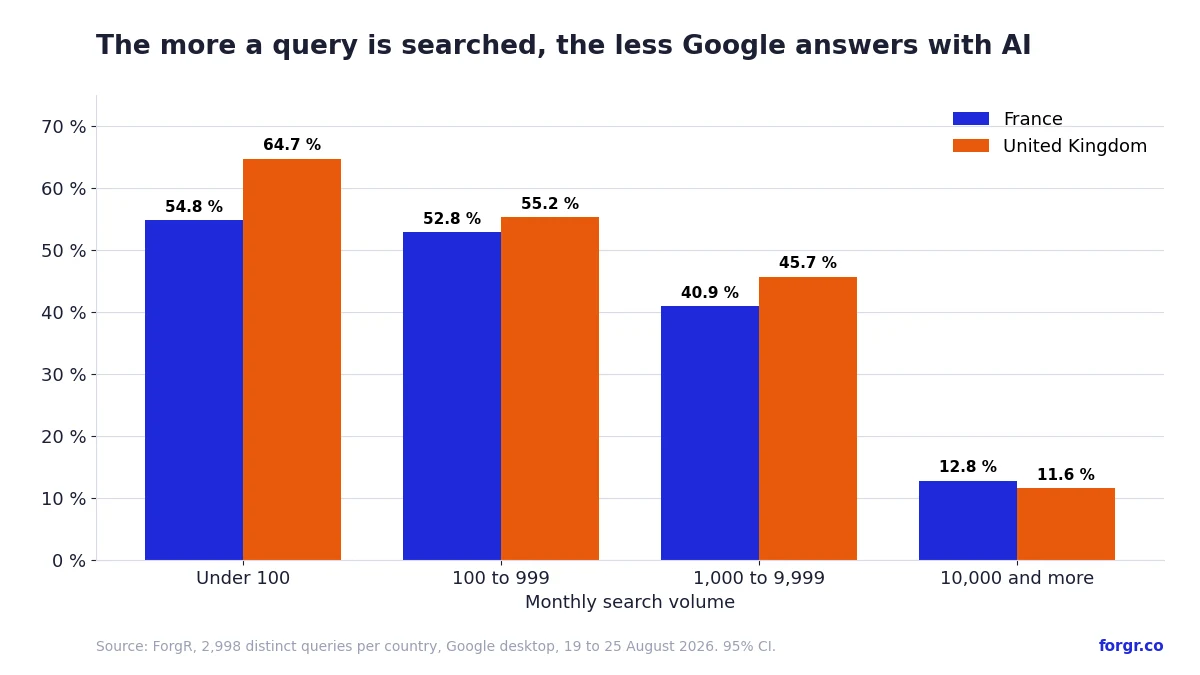
This is the most counter-intuitive result of the study. The AI answer rate declines steadily with search volume, in both countries: 64.7% in the UK and 54.8% in France below 100 monthly searches, 55.2% and 52.8% between 100 and 999, 45.7% and 40.9% between 1,000 and 9,999, then 11.6% and 12.8% at 10,000 and above.
Weighted by search volume, that is, seen from the readers' side rather than the queries' side, the rate drops to 13.6% in the UK and 17.6% in France. On the big breaking-news queries, Google shows its news blocks and its classic results, not a synthesis. The AI Overview occupies lukewarm news: the name you check, last week's story, the biography.
The register confirms it. Biographical queries trigger an AI answer in 75.6% of cases in the UK and 68.2% in France; factual queries in 54.4% and 46.3%.
3. One query in four changes status within the week
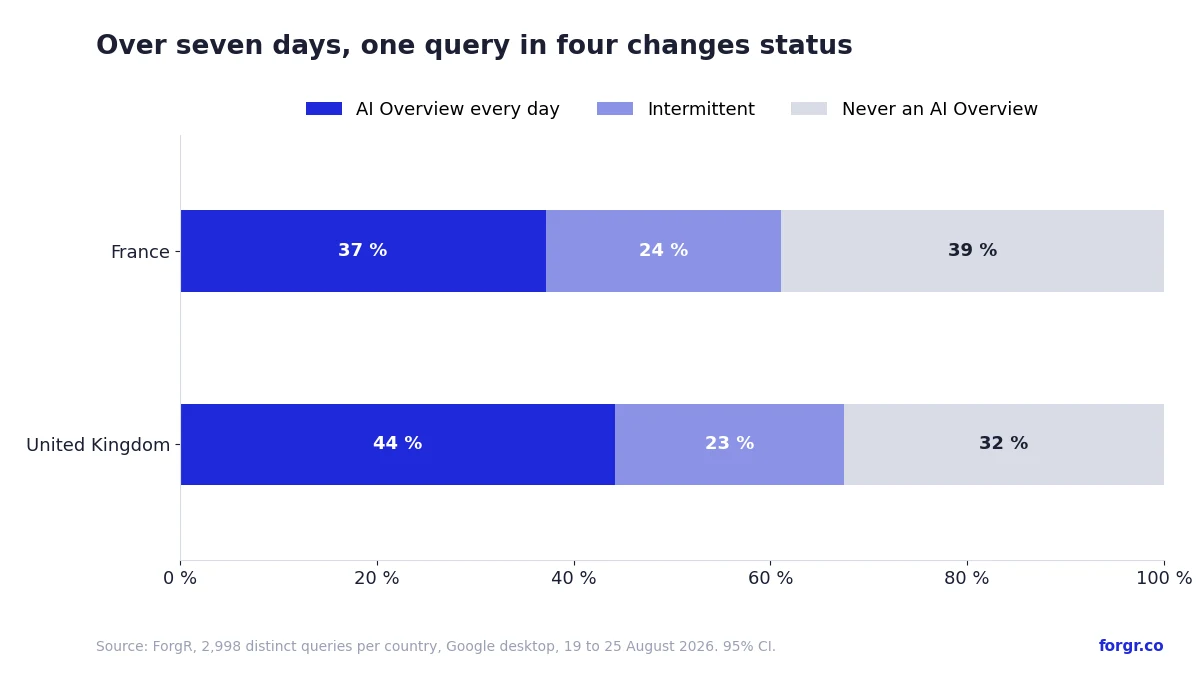
Over seven days, 44% of UK queries and 37% of French ones show an AI answer every single day; 33% and 39% never do. The remaining quarter, 23% in the UK and 24% in France, flips at least once. From one day to the next, 7% of queries change status.
The practical consequence: a measurement taken on a single day is off by about three points on the rate, and completely wrong on a given query one time in four. Single-pass studies describe a snapshot, not a state.
4. What Google cites: Wikipedia and platforms first, then the press
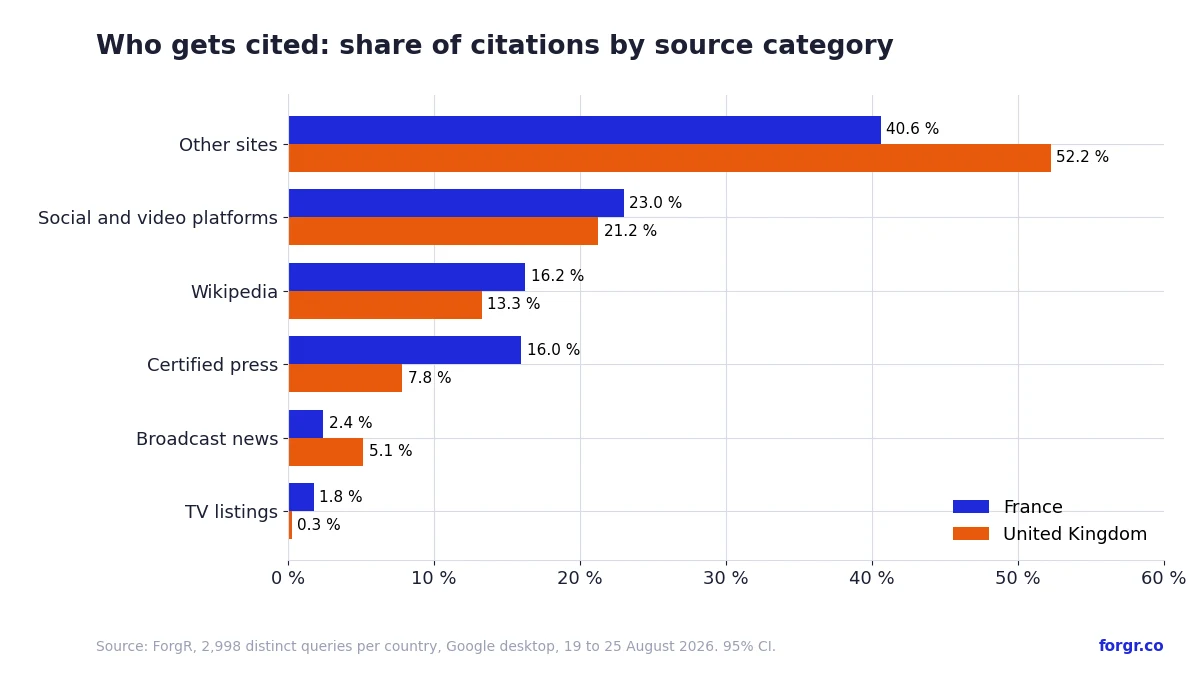
Across 58,384 domain citations in the UK and 46,700 in France (402 UK answers, 3.3%, and 64 French ones, 0.6%, cite no source at all), the largest category is "other sites" (institutions, official sites, brands): 52.3% of citations in the UK and 40.6% in France. On the UK side, it holds about 1,700 citations of non-certified foreign press (people.com 694, forbes.com 345, businessinsider.com 257, nytimes.com 225, variety.com 179), 2.9 points the press loses by construction; on the French side, dailymotion.com (930) and the Yahoo aggregators. Then come social networks and video platforms (21.2% and 23.0%), Wikipedia (13.3% and 16.2%), certified press (5.9% in the UK, or 7.8% with regional titles and magazines, and 16.0% in France), then broadcast news (5.1% and 2.4%).
Wikipedia is the most cited domain in both countries (12.0% of citations in the UK, 13.9% in France), followed by Facebook, YouTube and Instagram. On the panel's queries, Google's AI cites the public figure's Facebook page or Instagram account more often than the article about them. Without YouTube, social networks account for 15.5% of citations in France, against 16.0% for certified press: a draw. In the UK, the gap holds either way (15.1% against 7.8%). Likewise, on topics of French origin alone, certified press and social networks are level (21.5% against 21.2%): the headline describes the full panel and the UK unambiguously, France only narrowly.
Certified press weighs 16.0% of citations in France against 5.9% in the UK (7.8% with regional titles and magazines); the bootstrap intervals do not overlap. An indicative comparison: the two lists are not built the same way, and on topics of national origin alone the gap narrows (21.5% in France, 12.8% in the UK with the additions, 9.5% on the strict scope). Taking all media together, 20.2% versus 13.3%. And 51% of French AI answers cite at least one media outlet, against 37% of British ones.
The press that gets cited is not the one you would expect. In the UK, The Guardian (1,051 citations) alone captures 31% of the citations going to strictly certified press, ahead of The Sun, the Mirror, The Independent and The Times. In France, gala.fr is the most cited press title, ahead of Ouest-France, Le Parisien, Voici and Paris Match; celebrity magazines (gala.fr, voici.fr, closermag.fr, parismatch.com) account for 31% of press citations, 25% without Paris Match.
5. The BBC is the British press
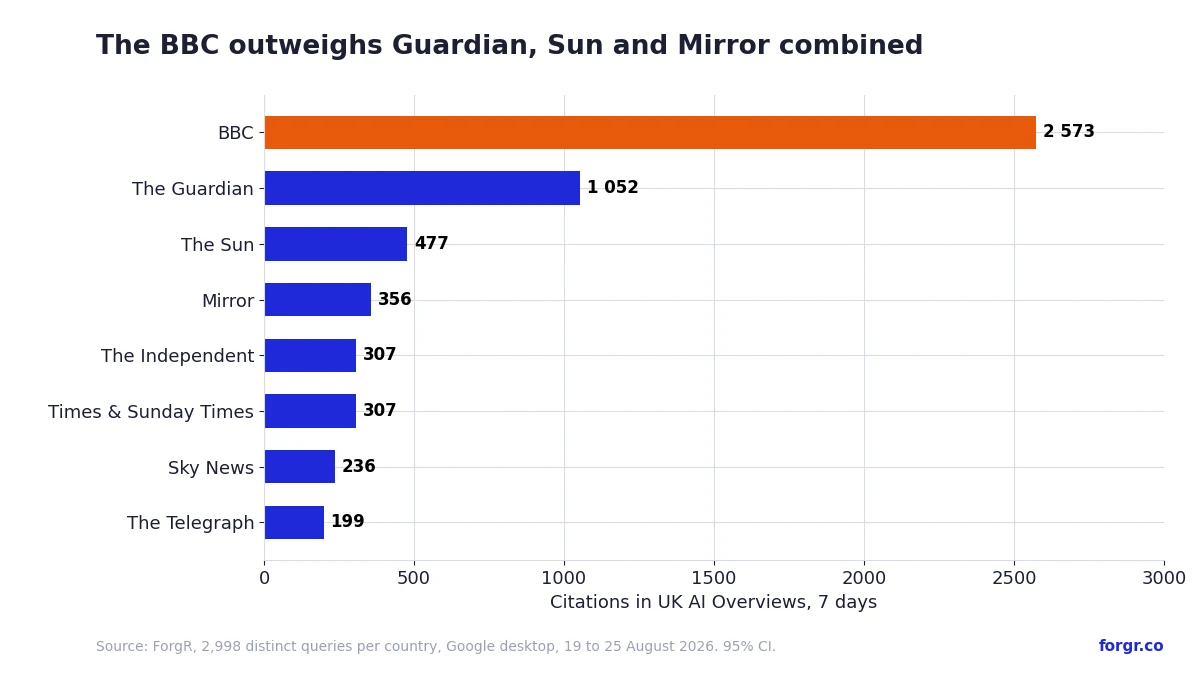
In the UK, bbc.co.uk and bbc.com together collect 2,573 citations, 4.4% of the total, more than The Guardian (1,051), The Sun (477) and the Mirror (356) combined. The Independent and The Times follow with 307 citations each. The BBC alone weighs three quarters of what strictly certified press weighs (5.9%), 56% with regional titles and magazines. Remove it, and British public service news disappears from AI answers: ITV receives 104 citations over seven days, Channel 4 receives 46, Sky News 236.
Nothing comparable in France, where public broadcasting is almost absent from citations, for a reason that audience does not explain and that this study does not measure (see lesson 7).
6. The UK's top 50 news brands receive 16% of citations
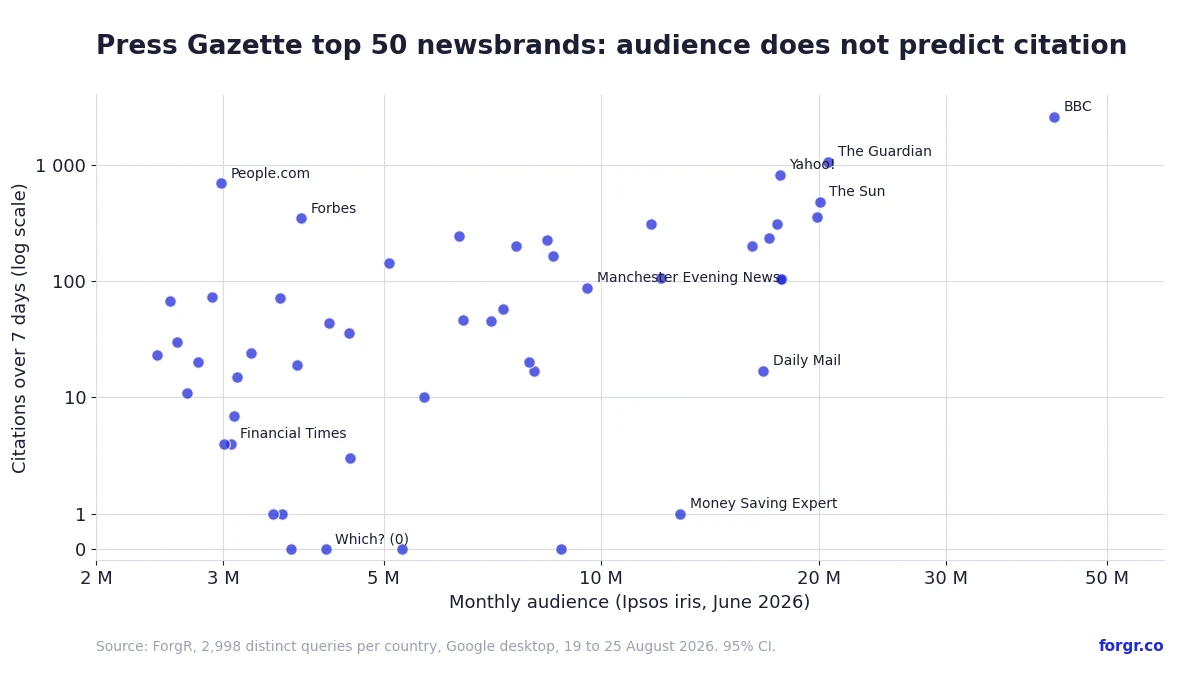
We cross-referenced the UK citations with Press Gazette's ranking of the 50 largest news brands by audience (Ipsos iris data, June 2026). These 50 brands receive 16.1% of citations 15.8; 16.4. 46 are cited at least once. But the distribution is highly concentrated: the BBC and The Guardian capture 38.5% of those citations between them.
Audience does not predict citation. The Daily Mail, the country's tenth brand with 16.8 million monthly readers, receives 17 citations in seven days. People.com, an American magazine ranked 43rd, receives 694, more than The Sun. Yahoo!, which is not a publisher, receives 819.
7. Ten well-ranked French outlets that the AI never cites
For every page where an AI answer appears, we compared the first ten classic results with the cited sources. Ten French media outlets appear in the top 10 of at least 50 pages with an AI answer over seven days, and are never cited. Records are counted page by day: a query ranked on seven days counts seven times.
| Domain | Top 10 records (pages with an AI answer) | of which top 3 | Distinct queries | Citations |
|---|---|---|---|---|
| radiofrance.fr | 871 | 299 | 166 | 0 |
| franceinfo.fr | 615 | 272 | 134 | 0 |
| vanityfair.fr | 321 | 175 | 60 | 0 |
| france3-regions.franceinfo.fr | 208 | 67 | 45 | 0 |
| telerama.fr | 180 | 50 | 38 | 0 |
| challenges.fr | 119 | 17 | 22 | 0 |
| vogue.fr | 91 | 45 | 21 | 0 |
| admagazine.fr | 87 | 57 | 16 | 0 |
| courrierinternational.com | 78 | 21 | 13 | 0 |
| france24.com | 55 | 21 | 12 | 0 |
In total, 2,625 top 10 records (a query ranked on seven days counts seven times), including 1,024 in the top 3, or 527 distinct queries adding up the ten outlets, for zero citations. This is not a relevance issue: Google ranks these pages, it does not cite them. The heaviest case is not at zero: lemonde.fr, 1,407 top 10 positions (671 in the top 3) and 11 citations in seven days, 0.8 citation per 100 positions. The exclusion covers Radio France, France Télévisions and France Médias Monde, Condé Nast titles (Vanity Fair, Vogue, AD), the Le Monde group on three titles (Le Monde almost absent, Télérama and Courrier international at zero) and Challenges.
In the UK, no outlet shows this profile: every title ranked at least 50 times is cited, if only a little.
Nothing visible on the home pages (nosnippet directive) explains the gap; article pages and HTTP headers were not checked systematically. Blocking Google-Extended in robots.txt, common among these sites, does not apply to AI Overviews according to Google. The most likely explanation lies elsewhere: the opt-out Google offered French publishers before the 22 July launch (Journal du Net, 22 July 2026). The "ranked but never cited" profile is exactly what it would produce, and it has no known equivalent in the UK. We cannot assert it for each of the ten: only the publishers concerned, or Google, can confirm it, and we have put the question to them. What the measurement establishes is the fact and its order of magnitude: for these ten outlets, including Radio France, France Télévisions and France Médias Monde, Google's AI answer is a space where they do not exist, by choice or by default.
8. Three cited URLs in ten do not come from the top 10
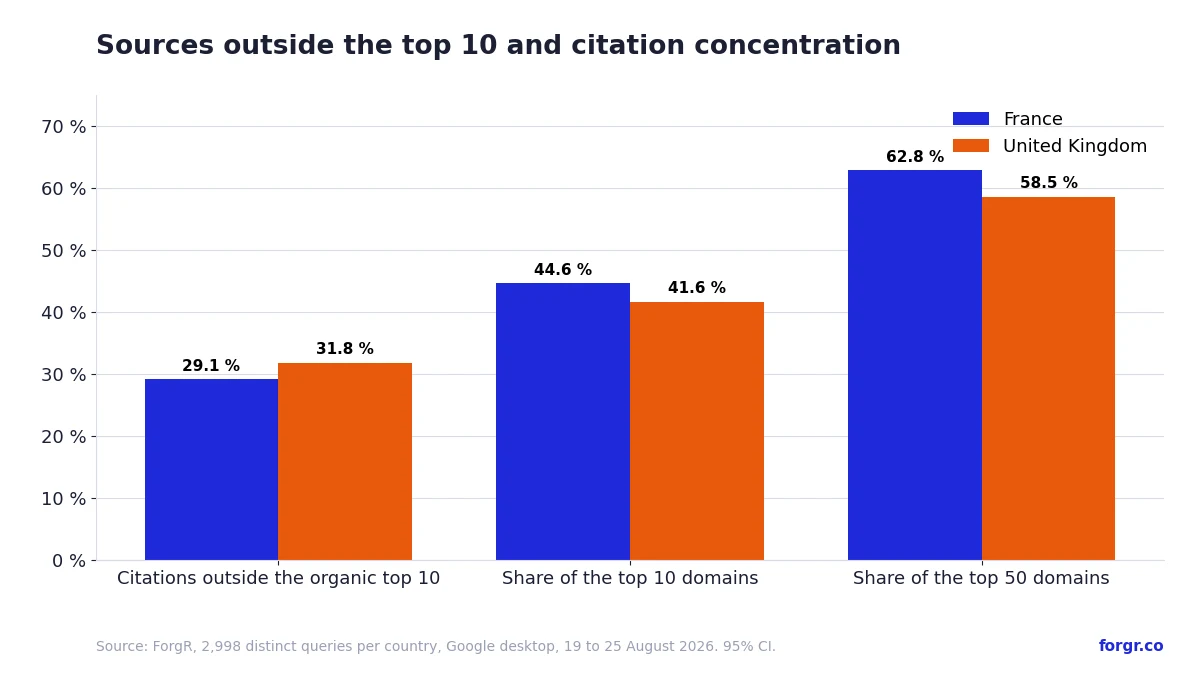
31.8% of cited URLs in the UK and 29.1% in France come from domains absent from the first ten classic results on the same page. The result is consistent with our August study on commercial queries (42.3% of cited domains outside the top 10): on news, the AI answer follows the classic results more closely, but three cited URLs in ten come from elsewhere.
The long tail is real but concentrated: 2,826 domains cited in the UK, 2,219 in France, a quarter of them cited only once. The top ten domains capture 41.6% of citations in the UK and 44.6% in France. Among media alone, ten domains capture 73.4% of citations in the UK and 52.7% in France.
What this changes for publishers
For the British press, the measurement lands as the CMA sets the rules, with an order of magnitude nobody had: on news, strictly certified press receives 5.9% of citations (7.8% with regional titles and magazines), the BBC 4.4%, Wikipedia 13.3%, social networks 21.2%. And audience is no protection: the Daily Mail is almost absent, People.com sits ahead of The Sun. A publisher that does not track its AI citations does not know whether it has disappeared.
For the French press, two results. First, certified press is cited more than in the UK (16.0% against 5.9%, an indicative comparison), and celebrity magazines are what drive the figure. Second, ten outlets, including Radio France, France Télévisions and France Médias Monde, are excluded from citations while being ranked. If it is a choice, their readers and advertisers deserve to know; if it is not, it deserves to be fixed.
For everyone, variability. A quarter of queries change status within the week, and the overall rate gained three to four points in seven days. An AI Overview rate given without a date or a confidence interval means nothing.
Limitations
Desktop only, at country level with no city, seven consecutive days in August: these are dated figures, and the measured week itself shows a three-to-four-point rise whose cause our data does not establish.
The press reference lists are not symmetrical. The ACPM certifies sites by name; the British lists are rebuilt from PAMCo, Newsworks, Newsquest and Reach, and under-represent local press outside those groups. The comparison on press in the strict sense is therefore indicative; the "all domains" and "media" scopes are comparable. We publish both British values, with and without the regional and magazine additions. The intervals on citation shares treat the seven records as independent although the same answers cite the same domains every day; they are therefore too narrow, and the conclusions rest on the bootstrap intervals of the rates.
The panels over-represent low-volume topics, which volume weighting corrects, at the cost of a wider confidence interval. Source classification is mechanical: a site absent from the reference lists falls into "other", the largest category, which on the UK side holds about 1,700 citations of non-certified foreign press (2.9 points the press loses by construction) and on the French side dailymotion.com and the Yahoo aggregators.
Finally, a citation is not a click. This study measures who Google cites, not who gets the traffic.
Data and how to cite
Everything can be downloaded from the study page: rates by day, country, theme, register, volume and origin, cited domains with their category, the Press Gazette top 50 breakdown, organic presence of media outlets and the full aggregation report. CC BY 4.0 licence. Raw queries and day-by-day records are provided on request to researchers and journalists.
To cite this data: ForgR, AI Citations Barometer: France and the UK, August 2026 edition (2,998 distinct queries per country on news topics, measured from 19 to 25 August 2026). https://forgr.co/en/studies/news-ai-overviews-france-uk-2026-08/ This article is the analysis of the first edition of a quarterly barometer; the next wave is scheduled for November 2026.
A ForgR study, conducted by Gilles Helleu and Paméla Michel, co-founders.